

Important: This is not official medical advice. It comes from personal experience shared by Swift Movement coaches and the parkour community, along with medical research. Tell a parent or trusted adult when you hurt your ankle. A doctor or physical therapist should check serious or unusual injuries.

Rolling an ankle can happen during a jump, landing, tic-tac, or wall run. The hard part is knowing what to do next.
This guide gives you three simple goals:
- Know when to stop and get help.
- Know when it may be safe to start easy training again.
- Build your ankle strength back one step at a time.
Ankle injuries are common in parkour. In a survey of 180 parkour athletes, about two out of three said they had hurt an ankle before. That is why a smart return matters.
Stop and get help if…
- You cannot take four steps.
- Your ankle or foot looks bent or out of place.
- Your foot feels numb, cold, or very weak.
- You have sharp pain right on an ankle or foot bone.
- Swelling or pain is getting worse.
- Your ankle keeps giving way, catching, or locking.
- You are not sure what happened.
Do not test a hurt ankle with more jumps. Tell a parent, coach, or trusted adult. When an injury seems serious, get help from a doctor or physical therapist.
Can I keep training today?
Red light: Stop parkour
Stop if you have sharp pain, a limp, fast-growing swelling, or an ankle that feels wobbly. Sit out and tell an adult.
Yellow light: Change the plan
If you can walk normally but the ankle still feels sore or strange, skip jumps, drops, running, and hard landings. With a parent and coach, you may be able to do an activity that does not load the ankle, such as seated or easy upper-body work.
Green light: Start easy
Easy parkour may be okay when you can walk, balance, hop, stop, and turn without pain, limping, or the ankle giving way. Start low and slow. Stop if symptoms return.
A green light is not a medical diagnosis. If the injury was serious, wait until a doctor or physical therapist says you can return.
Five ways to make your ankle strong again
Move to the next step only when the current one feels controlled. Sharp pain, more swelling, or a new limp means you did too much.
- Move it gently. Try slow ankle circles or draw the alphabet with your toes. Stay in a comfortable range.
- Raise your heels and toes. Start while sitting if needed. Later, try standing calf raises while holding a wall.
- Practice balance. Stand on the hurt foot near a wall or sturdy object. Work toward 20 to 30 calm seconds.
- Add small two-foot jumps. When walking and strength work feel good, try tiny jumps and quiet landings on both feet.
- Add one-foot work last. Build toward small single-leg hops, easy precisions, light jogging, and gentle changes of direction.
Good control matters more than doing lots of repetitions. A physical therapist can help choose the right amount for your injury.
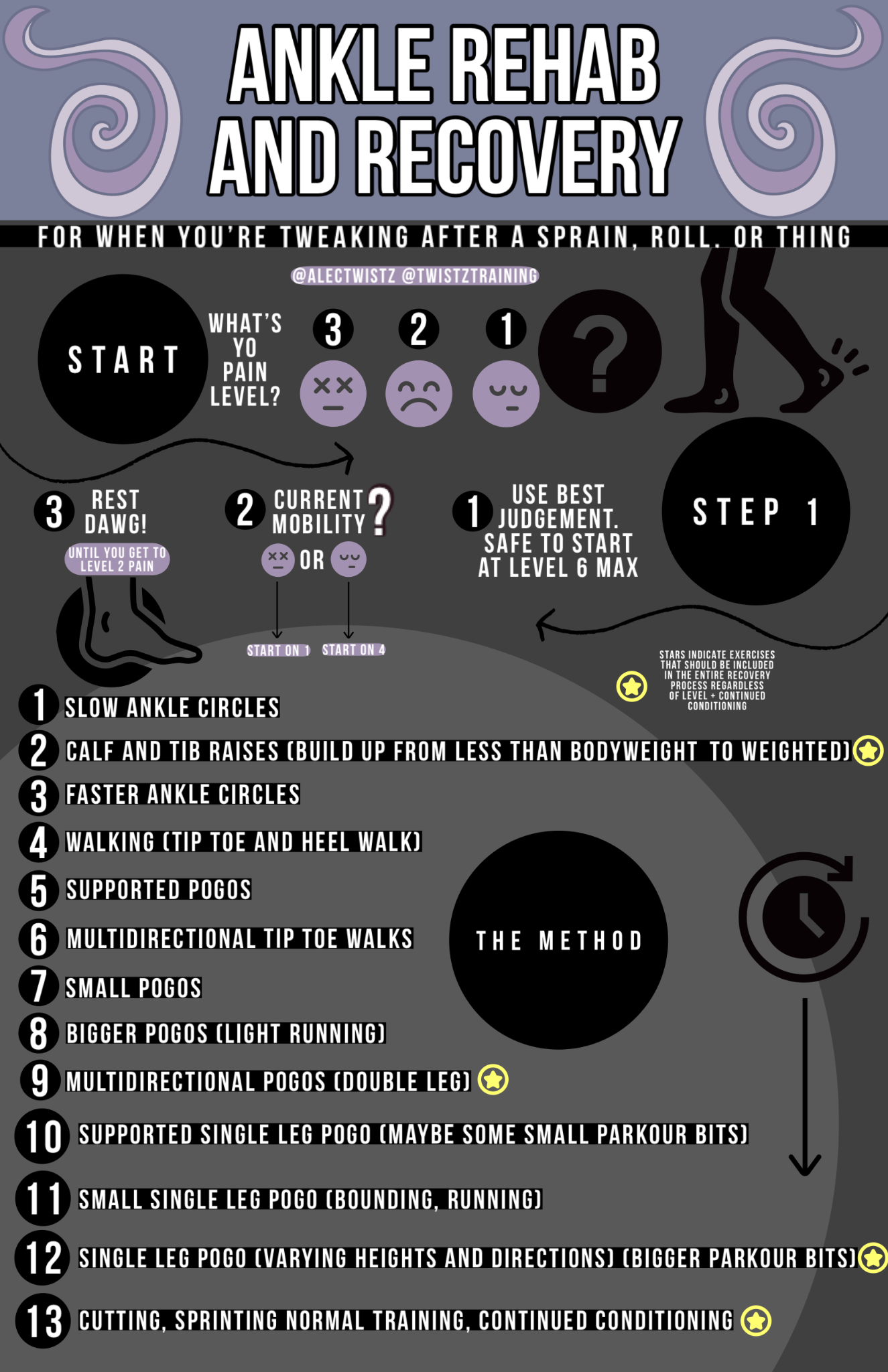
Community infographic by @alectwistz and @twistztraining.
The big idea in Alec’s chart
You do not need to learn every step in the chart at once. The main idea is simple: begin with gentle movement and strength, then add two-foot jumping, then one-foot jumping, and add speed and direction last.
Use the next-day check
Check your ankle later that day and again the next morning. If pain, swelling, or limping is worse, the last step was too hard. Go back to something easier.
Ready for parkour again?
This coach-friendly checklist can help you decide when to try an easy return. It is not medical clearance.
- You can walk and use stairs without pain or a limp.
- You can balance on the hurt foot for 30 seconds.
- You can do slow calf raises with good control.
- You can do 10 tiny two-foot hops, then a few tiny one-foot hops, without sharp pain or wobbling.
- You can jog, stop, and turn with control.
- An easy practice does not make the ankle worse later or the next morning.
For your first sessions back, keep jumps low, land on clear surfaces, and take more breaks. Save big drops, full-speed runs, and hard outdoor challenges for last.
What if the ankle pinches?
A sharp pinch at the front or back of the ankle can be different from a simple sprain. Do not keep forcing it because you think the ankle only needs more stretching. If the pinch keeps coming back, or the ankle catches or locks, ask a doctor or physical therapist to check it.
Returning to parkour at Swift
Tell your Swift coach about your ankle before class. We can lower the height, reduce impact, slow the pace, and help you choose safer drills. Coaches can change the training, but they cannot diagnose an injury or replace medical care.
If you are new to Swift, schedule your first class. If you already train with us, ask your coach to help you make a return plan.
Sources
- Parkour injury and training survey
- ChoosePT guide to ankle sprains
- PAASS return-to-sport checklist
- Ottawa Ankle Rules
- Review of front-of-ankle impingement
Important: This is not official medical advice. This article comes from personal experience shared by Swift Movement coaches and the parkour community, together with published research. It cannot diagnose an injury or replace care from a doctor or physical therapist. Stop training and get help if symptoms are serious, unusual, getting worse, or not improving.